What Can I Build with Python in Cybersecurity?
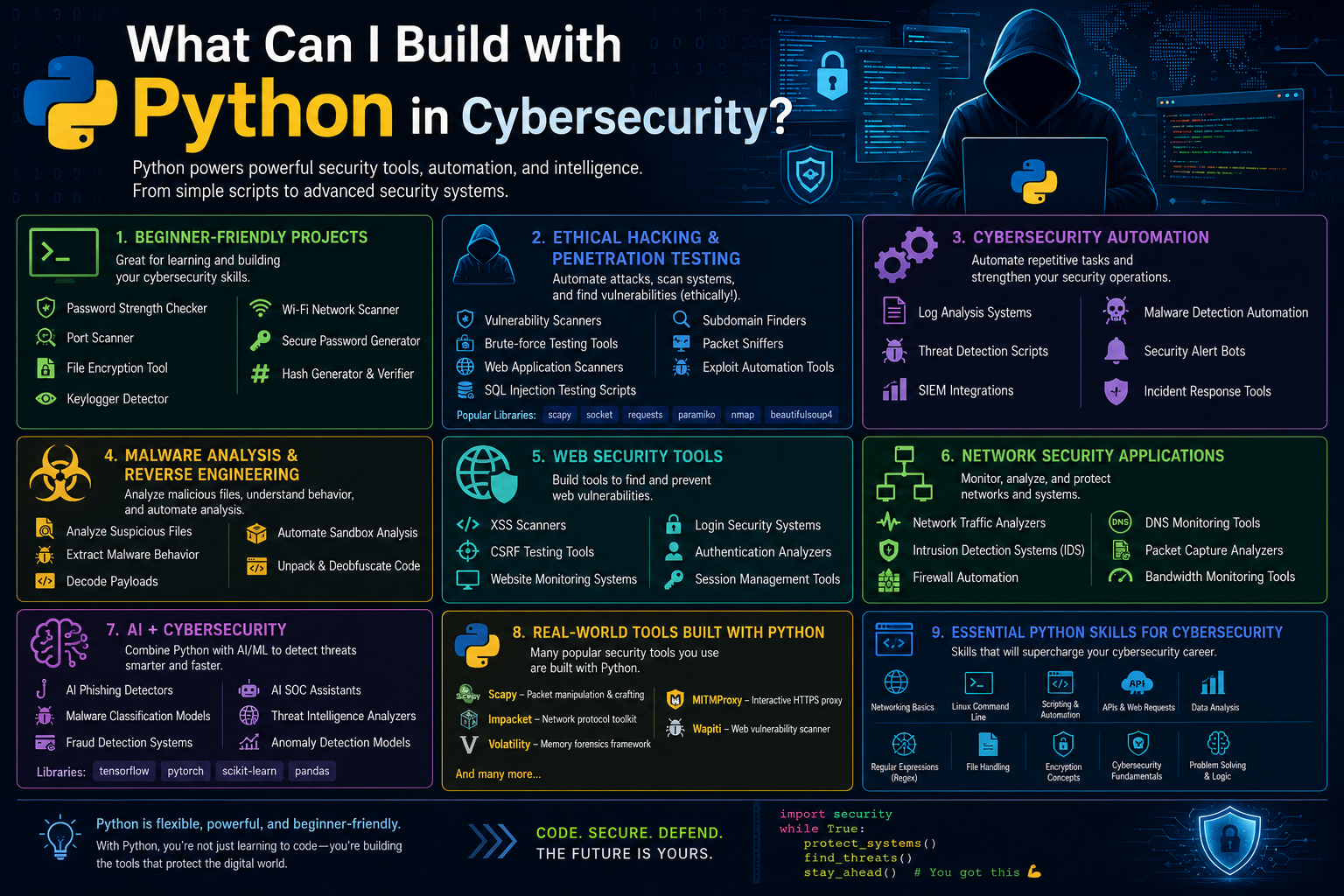
If you are learning Python and you are interested in cybersecurity, the combination you have chosen is one of the most practically powerful in technology in 2026. Python appears in 72% of security tool development and SOC automation workflows — making it not just a useful language for the field, but the dominant one. From junior SOC analysts writing their first log parser to senior engineers building machine learning-based intrusion detection systems, Python is the thread that runs through almost everything in modern defensive and offensive security.
The cybersecurity field is also facing a talent shortage of over 3.5 million unfilled positions globally, with salaries rising fast — many roles paying $130,000 to $150,000 USD and higher for professionals who can code, think critically about security, and build automated solutions. Building a portfolio of Python security projects is one of the most direct paths into that market. Here is a comprehensive guide to what you can actually build with Python in cybersecurity — from beginner projects you can complete this week to advanced tools that will genuinely impress hiring managers.
The Essential Python Libraries for Cybersecurity
Before exploring what to build, it is worth understanding the libraries that make Python so capable in this space. Each serves a distinct purpose:
- Scapy — The Swiss Army knife of network packet manipulation. Forge, decode, send, capture, and analyse packets across a wide range of protocols. Indispensable for network scanning, traffic analysis, and security testing.
- Requests — Essential for web security testing and API interactions. Used in everything from web vulnerability scanners to threat intelligence API integrations.
- Paramiko — Automates SSH connections for remote server management and security audits. Used by penetration testers and system administrators alike.
- PyCryptodome — The modern fork of PyCrypto, used to implement AES encryption, RSA signatures, and secure hashing (SHA-256) to protect sensitive data at rest and in transit.
- Scikit-learn and TensorFlow — Machine learning libraries increasingly used for anomaly detection, malware classification, and behavioural analysis in security operations.
- YARA — For detecting malware patterns. Used extensively by incident responders to identify malicious files based on rules.
- PyMISP — For querying threat intelligence from MISP (Malware Information Sharing Platform), enabling automated enrichment of security alerts.
- Beautiful Soup — Web scraping for security research, CVE tracking, and threat intelligence aggregation.
Beginner Projects: Build These First
1. TCP Port Scanner
A port scanner identifies which services are running and which ports are open on a target system — a fundamental step in any vulnerability assessment or network reconnaissance exercise. Building one yourself using Python’s socket module teaches you how TCP connections actually work at a foundational level: the three-way handshake, SYN packets, and connection state management. Every script runs with Python’s standard library — no pip installs required. Once you have a basic version working, extend it with multi-threading so it completes scans in seconds rather than minutes. This is the first project recommended by virtually every Python cybersecurity curriculum in 2026, and for good reason — it teaches network fundamentals through actual code rather than abstract theory.
2. Log File Analyser
Security Operations Centre (SOC) analysts spend a significant proportion of their working day processing log files — looking for anomalies, failed login attempts, unusual traffic patterns, and indicators of compromise. A Python log analyser automates this process: it ingests log files in standard formats (syslog, Apache, Windows Event Logs), parses them for specific patterns using regular expressions, and surfaces alerts when suspicious activity thresholds are breached. This is the kind of tool that SOC analysts actually use — one analyst, three months into their first security job, used a similar script to identify a credential stuffing attack — 847 failed login attempts across a 90-minute window — that might otherwise have gone unnoticed until Monday morning. Making the analyser accept command-line arguments so it works with different log formats, then scheduling it to run hourly with cron and send email alerts when changes are detected, turns a learning exercise into a genuinely deployable tool.
3. File Hash Integrity Checker
File integrity monitoring is a cornerstone of security operations — detecting when critical system files have been modified, which is one of the most reliable indicators of a successful intrusion. A Python hash integrity checker computes SHA-256 checksums for a defined set of files, stores them in a baseline database, and compares them at regular intervals — alerting when any file has been altered. This project teaches hashing, file I/O, database interaction, and automated monitoring in a single, useful tool. Once you have the basic version working, extend it to query the VirusTotal API to check file hashes against known malware signatures — turning a simple integrity monitor into a basic malware detection system.
4. Password Strength Checker and Breach Database Scanner
A password checker evaluates the strength of a given password against a defined set of criteria — length, complexity, character variety, and absence from known breach databases. Using the Have I Been Pwned API (which allows you to check whether a password hash appears in their database of billions of breached credentials without sending the actual password), you can build a tool that evaluates both strength and breach exposure in a single function. This project introduces API interaction, cryptographic hashing, and privacy-preserving API design (the k-anonymity model used by HIBP) — concepts directly applicable to real security engineering roles.
Intermediate Projects: Building Real Security Tools
5. SSH Brute Force Detector
SSH brute force attacks — automated attempts to guess login credentials by trying thousands of username and password combinations — are among the most common attacks against internet-facing servers. A Python SSH brute force detector monitors authentication log files in real time, counts failed login attempts by source IP address, and automatically triggers firewall rules (using iptables or ufw commands executed via Python’s subprocess module) to block offending IPs once a threshold is exceeded. This project combines log parsing, attack detection, and firewall automation — three skills that appear explicitly in SOC analyst and systems security engineer job descriptions.
6. Network Packet Capture and Protocol Analyser
Using Scapy, you can build a packet capture tool that intercepts network traffic on a specified interface, decodes the protocol headers, and logs or visualises the traffic — giving you a simplified, Python-built version of what Wireshark does commercially. This project teaches packet structure, protocol analysis, and traffic visualisation while giving you a deep, practical understanding of how data actually moves across networks. Extending it with anomaly detection — flagging traffic patterns that deviate from a learned baseline — introduces the machine learning dimension that is increasingly central to network security operations in 2026.
7. Phishing Domain Scanner
Typosquatting — registering domain names that closely resemble legitimate ones (for example, “paypai.com” or “g00gle.com”) — is a foundational technique in phishing campaigns. A Python phishing domain scanner generates typosquat variations of a target domain using homoglyph substitution and common typo patterns, checks whether each variant is registered, and queries domain intelligence APIs to assess their risk score. This project teaches DNS querying, API interaction, and threat intelligence — skills directly applicable to brand protection, threat hunting, and incident response roles. Adding QR code generation and scanning extends it into quishing (QR phishing) detection, one of the fastest-growing attack vectors in 2026.
8. Security News and CVE Aggregator
Staying current with emerging vulnerabilities requires monitoring multiple sources simultaneously — the National Vulnerability Database, vendor security advisories, security news sites, and threat intelligence feeds. A Python web scraper and RSS aggregator can pull CVE data, parse severity scores, filter by technologies relevant to your organisation, and deliver a curated daily security briefing to a Slack channel, email inbox, or dashboard. This project teaches web scraping with Beautiful Soup, CVE parsing, database storage, and API integration — while building something genuinely useful for any security team.
Advanced Projects: Portfolio-Level Work
9. Machine Learning-Based Intrusion Detection System
An ML-based intrusion detection system (IDS) uses Scikit-learn to train a classification model on network traffic data — learning what normal traffic looks like and flagging anomalies that may indicate scanning, exfiltration, or command-and-control communication. For deep learning applications, TensorFlow is used to create neural networks for User and Entity Behaviour Analytics (UEBA) — detecting insider threats that traditional rule-based systems miss. This is a final-year student or advanced practitioner project that demonstrates the convergence of data science and security engineering that employers in enterprise security are actively seeking in 2026.
10. Threat Intelligence Platform
A threat intelligence platform pulls actionable data from multiple open feeds — Indicators of Compromise (IOCs), C2 domains, malware hashes — normalises it, deduplicates it, and exports it to a SIEM or SOAR platform for automated enrichment of security alerts. Built with Python, ElasticSearch, and Kibana, and integrated with VirusTotal and AlienVault OTX APIs, this project demonstrates the kind of security engineering capability that distinguishes senior analysts and engineers from junior ones. Managing many threat intelligence sources at once remains a practical challenge in real security operations — building a tool that addresses it is a portfolio centrepiece.
11. Honeypot with Telegram Alerting
A honeypot is a deception defence system — a server or service that appears legitimate but is actually a trap designed to attract and detect attackers. A Python-based honeypot can simulate common services (MySQL, FTP, HTTP) using simple socket servers, log all interaction attempts with full metadata, and fire instant alerts via Telegram bot whenever a connection is made — giving you real-time visibility into who is probing your network and what they are looking for. Honeytokens — fake credentials or documents embedded in real systems that trigger alerts when accessed — extend the same principle into endpoint detection. This project combines socket programming, deception security principles, and webhook integration into a genuinely deployable defensive tool.
The Career Impact of Building Python Security Projects
Every project in this guide does two things simultaneously: it teaches you a concrete, applicable cybersecurity skill, and it produces a portfolio artefact that demonstrates that skill to a hiring manager. The cybersecurity hiring market in 2026 is skills-hungry and increasingly willing to evaluate candidates on demonstrated ability rather than credentials alone — particularly for SOC analyst, threat intelligence, and security automation roles.
A realistic 90-day roadmap for building a Python cybersecurity portfolio: spend the first 30 days on Python fundamentals and your first three beginner projects; spend days 31 to 60 on networking basics, setting up a virtual lab (using VirtualBox and vulnerable VMs from VulnHub), and completing the intermediate projects; spend days 61 to 90 on TryHackMe or HackTheBox challenges, contributing to an open-source security tool on GitHub, and building one advanced project to anchor your portfolio.
The most important ethical principle to carry through every one of these projects: only run security tools against systems you own or have explicit written permission to test. The cybersecurity community is small, reputation matters enormously, and the legal consequences of unauthorised scanning or testing are serious. Build everything in a controlled lab environment first. The skills transfer fully — and the legal exposure does not.